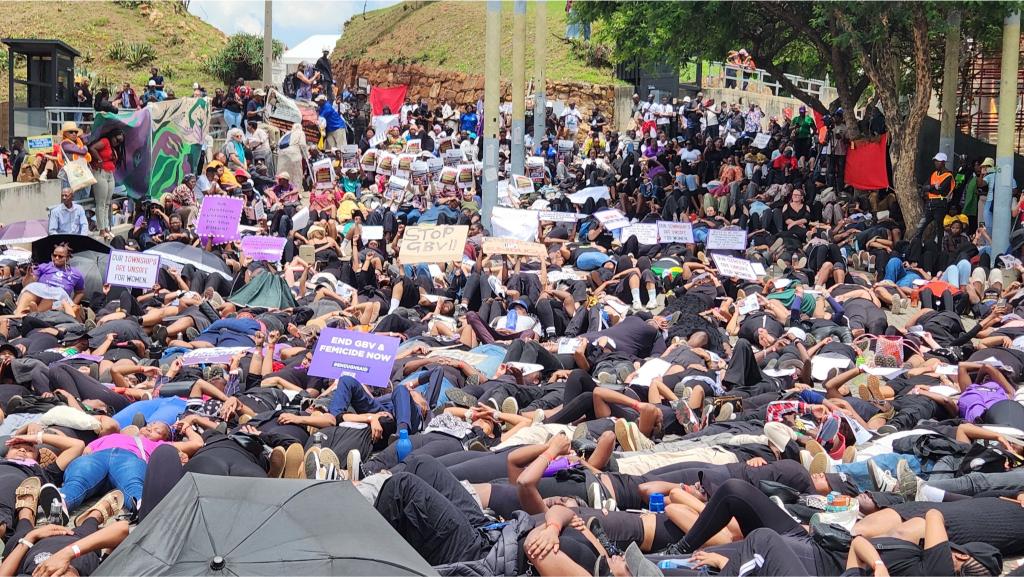
South Africa has officially recognised violence against women as a national disaster, responding to mounting public pressure and nationwide protests. On Friday, thousands of women lay down in a symbolic 15-minute act of remembrance at noon local time to honour the 15 women killed every day in the country.
The protest, which called for a temporary withdrawal from work, aimed to highlight the urgent need for government action against the rising tide of gender-based violence.
The state had previously resisted declaring such a disaster but changed course after acknowledging “the persistent and immediate life-safety risks posed by ongoing acts of violence.” South Africa experiences extremely high levels of gender-based violence, with female homicide rates five times higher than the global average, according to UN Women.
Cooperative Governance and Traditional Affairs Minister Velenkosini Hlabisa said the National Disaster Management Centre (NDMC) had reviewed earlier reports and considered new submissions from government departments and civil society before making the decision.
The designation allows government agencies to access allocated funds to implement programs aimed at reducing gender-based violence. Should these measures fail, the government may escalate to a full national state of disaster, enabling even swifter interventions.
Friday’s “lie-down” protests were held in 15 locations nationwide, including Cape Town, Durban, and Johannesburg. Support also came from regional allies in Kenya, Namibia, and Eswatini. Protesters dressed in black to signify mourning and resistance.
The G20 Women’s Shutdown, led by Women for Change, was supported by an extensive online campaign, including a petition with more than one million signatures and social media activism using the colour purple to raise awareness.
President Cyril Ramaphosa noted at the G20 Social Summit that South Africa had declared gender-based violence and femicide a national crisis in 2019. Shortly after, Minister Hlabisa confirmed that the issue had been upgraded to a national disaster.
Women for Change celebrated the announcement on Instagram, stating, “we have won” and that their “persistence has been recognised.” The group added, “We have written history together [and] we have finally forced the country to confront the truth.”
Activists have stressed that past laws and policies have often lacked follow-through. Cameron Kasambala, spokesperson for Women for Change, noted, “so many beautiful acts and legislations” were undermined by “lack of implementation and transparency.” She added, “Once the government truly reacts to this issue, I feel like we'll already be able to see a reaction on the ground. Because they set the precedent and the tone for how the country responds.”
The campaign attracted celebrity support, including Grammy-winning singer Tyla, with participants posting purple symbols like hearts, clothing, and nail polish in solidarity. Many travelled long distances to take part in the silent protests, highlighting the personal importance of the movement.
Some women, however, faced discouragement from employers against joining the demonstrations. Others, frustrated by government inaction, took self-defence into their own hands.
Lynette Oxeley founded Girls on Fire, which trains women to use firearms legally for self-protection. Many members have experienced assault, robbery, or other forms of violence. Prudence, who joined after being raped in 2022, recounted the difficulty of seeking justice: “I said: 'No'. I screamed, I cried but he didn't take no for an answer.” She added, “It isn’t a police problem, it is a nation problem.”
Oxeley emphasised that firearm training is a last resort. “It's not about actually defending yourself with a firearm. I want ladies to change what they think about themselves. Stop being silent,” she said. “Even if you do not win the fight, at least you are fighting back.”